Showing posts with label tattooed. Show all posts

Monday, November 11, 2013

Getting ready to train: What to bring.

You have finally decided to get some professional firearm training. You pay your deposit and are waiting for the day to come.  Here is what you should bring.

Check out the school's website. 

They will have a page listing the things you need to bring. Some of the things you may think you won't need, but it is on the list for a reason.

Guns

Make sure your gun is in good working order.  Clean and lube it before you go.

It is a good idea to bring a spare gun if you can.  If you don't have a spare gun, bring along some spare parts of the things that may normally break.  Training tends to put more stress on guns and gear than just plinking at the range.  A cleaning kit and lube would be a good idea as well.

If you are not able to bring a spare gun, the instructor may have back ups, although it will probably have a fee attached.

Ammo

Usually the listed round count for the class is the minimum you will shoot. You should bring at least a couple hundred rounds more than what is listed.  Some people say to bring 500 more, others say to double the recommended amount.

One other thing I do is pour all of my ammo out into an ammo can. You don't have to mess with a bunch of boxes and trays and there isn't any trash to keep up with. 

Eye and ear protection

You should bring some dark glasses, and some clear or yellow shooting glasses as well. 

You should really invest in electronic ear protection if you can afford it. These are ear muffs with microphones that let you hear what the instructor and other students are saying, and then automatically shut off when you shoot. It is so much easier than trying to hear through regular muffs or constantly putting your ear pro on and off. I use the Peltor 6S and they have worked well for me. Be sure to bring extra batteries. 

Magazines 

Most classes will list you need at least 2 or 3 magazines. I like to bring as many as I can. Reloading mags all day is a necessary part of the deal but I like to minimize it as much as possible. The less you have to stuff ammo in mags the better you can be paying attention to what the instructor is saying. 

I will have all of my magazines except for 2 loaded before I get there. I leave the 2 unloaded for the dry fire work at the beginning of class. If you are training with somebody you haven't worked with before it is a good idea to contact them via phone or email and make sure having your mags loaded before hand is ok.  You will probably want your gun to be unloaded when you arrive unless you have information otherwise.

You may also want to invest in a magazine loader such as those made by Uplula if you are going to a high round count course, or just aren't used to repeatedly loading mags with your thumb.

Holster, mag pouches, belt, etc.

Training is a great way to test out gear!  You get to see what works well, what works ok, and what you should probably replace.  You want to bring quality gear.

Your holster should be of a design that stays open at the top to ease reholstering.  You will be drawing and holstering a lot during the class and you don't want to be fumbling with the holster the entire time.  I personally like kydex holsters, but a good quality leather holster with a reinforced mouth works as well.  Another consideration with IWB holsters is the holster should be big enough to cover the entire barrel of the pistol.  Minimalist holsters have become popular for concealed carry but tend to be bad for training because the barrel and slide of your gun will become hot from firing a lot.  You don't want to burn your leg(or worse if you carry appendix IWB like I do!) from sticking a hot gun inside your pants with nothing covering it. 

Your belt, mag pouches, and any other gear used during class should be of high enough quality to not hinder you.  You want to be learning, and practicing all day, not fiddling with your gear.  Bringing a spare holster or two isn't a bad idea as well.

I am a firm believer that you should train how you carry.  But, if your EDC is a little .380 you carry in your pocket, you may want to bring another rig more suited to training.  Learning the fundamentals is the same with a full size duty gun as with a small pocket pistol.  If you go down this road, bring your EDC gear too and run at least a few drills with that setup.  Your instructor may have some tips for your specific method of carry as well, don't be afraid to ask.

One thing that recurred throughout this article is the need for spares.  You should bring spares for pretty much everything feasible.  Training is hard on gear, which is good.  If it is going to fail I would sure rather it happen during a controlled class than in some violent encounter on the street!  But at the same time, you don't want to have to sit the rest of the class out because your gun or a piece of your gear broke.


Again, the school's website should have a list of everything you need to bring.  I wanted to expand of some of the more important things and throw a few tips in there as well.  I hope you found this post helpful.  Feel free to leave comments or suggestions.  You can also contact me by the link at the top of the page if you have any questions I would be glad to help. 


Saturday, September 14, 2013

Cool Old Guns 2: H&R 733 .32 S&W Long Revolver

I recently picked up a little H&R .32 S&W Long revolver for practically nothing.  It is a 6 shot nickel revolver, model 733. This model was made from 1961 until 1986. H&Rs don't have the fit and finish of a Smith & Wesson or Colt but it isn't a bad little gun.


This one has some pitting and the nickel is pretty much gone from the cylinder. It is actually in better condition than the first picture I saw of it. 

I could only find 20 rounds for it locally. They are 85 grain hollow points from Hornady loaded by a small local outfit. I decided to go ahead and shoot 14 of them and keep the last 6 until I can pick up some more. 

This is the first six shots:

That's probably about 4 inches or so, and I wasn't trying to be super precise or anything. I was mostly just wanting to make sure it was going to function correctly.


Size comparison for the .32 S&W Long round:
.22 lr, .32 S&W Long, 9mm Luger, .44 mag, .223/5.56x45

Overall it's a pretty cool little old gun. Guns like this are fun to shoot if not useful for much. I wouldn't use it for home defense or concealed carry, but I wouldn't want to be shot by it either. 

~TattooedGunner

Sunday, August 11, 2013

Started work on our tactical range.

Me and my brother started building our own range a few days ago.  We are going to build multiple target stands and different cover/concealment areas.  All will be able to be moved so we can set up multiple stages, similar to IDPA or IPSC.  This will be a great way to better our shooting skills, and just enjoy some time shooting.

The cool thing is, all of this was made from materials scavenged from work and other places, so total cost for this is whatever the nails cost.  That leaves more money for ammo!  Now if I could just find some...

 This is what we have so far:

Target Stands:

These are overbuilt as heck, but we plan on using them for a while so that's a good thing.  I got the dimensions for IDPA targets off the internet and cut several out of scrap cardboard slip sheets. 


Cover/Concealment wall: 

These can be used with the window or just as a wall.


This is one of the target stands set up.  We were using it for the extremely tactical role of sighting in Jesse's .22 mag.

Here is a video of everything set up:


This is just a start, we are going to build a lot more stuff as we get time.  I want to get some steel targets to add as well.

Thanks for checking it out, and don't forget to like Tattooed Gunner on Facebook at https://www.facebook.com/TattooedGunner

~Tattooed Gunner

Monday, July 22, 2013

Tattoo Artist Interview: Stan from The Tattoo Shop in Albany, Georgia

Today I have an interview done with Stan from The Tattoo Shop in Albany, Georgia.  Stan's website can be found at TattoosByStan.com


So, Stan, How long have you been tattooing?

Going on lucky 13yrs.


What did you do before you were a tattoo artist?

Graphic arts

What got you interested in being a tattoo artist?

My Grandfather had some pretty gnarly WWII Navy tattoos. Always was interested in them after seeing those.

Did you do an apprenticeship? If so, how long?

About 2 yrs


How old were you when you got your first tattoo?

18. It was some tribal shit, yay 90's!

Who would you say influenced you as an artist, tattoo or otherwise?

Skateboard art, Traditional tattoo art mostly

What do you like to do besides tattooing?

Spend time with my Wife, and twin boys, Shoot guns, and collect Star Wars and horror props.


What is your favorite “style” of tattoo to do?

I like it all really. Have the most fun with horror themed.


What is the strangest tattoo you have ever done?

Would definitely say a butt with a pirate hat, and a patch that says "Swab me poop deck"


What is your favorite part of being a tattoo artist?

Being able to enjoy what you do.

What is your least favorite part?

Dealing with the occasional asshole.

What do you think about “scratchers?”

Broken hands can't tattoo.

Where do you see yourself in 10 years? Still tattooing?

Damn sure hope so. It's a riot, makes going to "work" not such a bad thing.


Seeing as how my blog is Tattooed Gunner, how do you feel about firearms and the 2nd amendment?

I think they are essential to the country, and for our freedom. 'Merica!!!

What is your favorite gun (that you actually own or otherwise)?

Probably my Glock 30s, it's always with me.


Thanks to Stan for doing the interview.

Feel free to comment, and share!

Check me out on facebook at www.facebook.com/TattooedGunner

~ Mike the Tattooed Gunner


Monday, July 8, 2013

Getting tattooed: What to expect during and after.

So you have found a great artist, decided on what you want to get and where. Good for you!  Here is what to do next:

  • Go talk to the artist.  
    • Stop by the shop and discuss with the artist what you want and where.  He will give you feedback and you can come to a conclusion.  This needs to be done in person, not over the phone or on facebook. Calling ahead to see if the artist is free is ok.  If you get there and the artist is busy, ask how long until he is done or taking a break.  Tell the person at the counter you are wanting to talk to the artist about a tattoo.  If he is busy you can wait or come back.  The best time to go is during the week, generally as close to when they open as possible.  You are going to have this for the rest of your life so there is no reason to rush this.
    • This is also a good time to discuss price.  Ask what the artist thinks the piece will cost.  If it is a big or detailed piece he may not be able to give you a definite answer but should be able to put it in the ballpark.  Do not try to haggle the price down!  Do you really want somebody to permanently mark on you who you implied wasn't worth his price?
    • After you talk to the artist you can set up an appointment.  You may also need to pay a deposit to hold your time slot, especially if you are using a busier artist.

So you got an appointment, and you wait and wait and finally the day comes!  What should you do, and what can you expect once you get to the shop?

  • Take a shower before you go!
    • This should be common sense.  You are going to be spending time with your artist leaned over close to you, you shouldn't stink.  Also, a fresh tattoo is technically an open wound.  You do not want it to get dirty and get infected.
  • If you are getting inked somewhere with a lot of hair, shave the area before you go.
    • The tattoo artist will shave the area again anyway, but there is no point in him having to spend 10 minutes trying to clear your jungle of arm hair off.
  • Show up early.
    • Show up before your appointment to have time to fill out the paperwork and get ready.
  • DON'T drink, do drugs, or take any sort of pain medication that may include blood thinners.
    • You WILL bleed when you get a tattoo.  Don't do anything to make yourself bleed more.
    • In most(if not all) places, it is actually illegal to tattoo somebody that is drunk.  Don't do it.
  • DO eat before you go.  Being stabbed thousands of times with a needle is a shock to your body.  It is fairly common for your blood sugar to drop and you can actually pass out.  This is more embarrassing than anything.  NOTE: While you are being tattooed on, if you start to feel woozy or lightheaded AT ALL, TELL THE ARTIST!  This happens, and he will know what to do.  Nothing wrong with taking a break and drinking a coke or eating something.
  • Go over any last minute updates, or any questions or concerns you may have before you get started.  Once you start, you are committed.
  • The drawing will be put onto your skin via transfer paper.  This gives the artist a "stencil" or guide for doing the outlining.  Unless you are really brave and let them do it freehand!  
  • The artist will get you situated where he can get to the area easily.  Then he will get out all of the supplies he needs to do your tattoo.  All of your needles will be brand new, taken out of the pack in front of you.  They then get disposed of when you are done.  The artist will usually use two separate tattoo guns, one for outlining, and one for shading.  All ink used will be put in small disposable ink cups so the main bottle does not get contaminated.
  • GO TIME!!


  • About the pain: IT HURTS, REALLY REALLY BAD!!!!  Actually, depending on your pain tolerance and location of the tattoo it really isn't that bad.  Generally speaking, the closer to the bone the location is, the more pain there will be.  Also, the more detail in the piece, the more times the same spot is going to be gone over, the more it will hurt.
  • Actually getting a tattoo is my favorite part.  I love to watch the art come out of nothing.  Even if a stencil is used, the skill is in getting crisp lines that aren't jagged or crooked.  The shading and coloring is where the great artists are distinguished from the good ones.
  • During the tattoo, the artist will wash the excess ink off with antibacterial green soap.  This stuff has a distinctive clean smell.  I can't smell it without thinking "tattoo shop." 
  • When the tattoo is done you get to check it out.  If you notice anything you don't like point it out.  Sometimes a spot may need touched up.  
  • Congratulations, you have your first tattoo!  The artist will bandage the spot up, you can pay anything you didn't pay for before you got started, and you are ready to go.  If you like it, Tip The Artist!
  • If you decide you want to use any special creams or lotions made just for helping tattoos heal, you can also get them at the shop at this time.  Ask the artist if you aren't sure.  He will give you instructions on how to care for the tattoo.
Aftercare:
  • After you leave the shop, leave the bandage on for at least a few hours.  4-6 is usually sufficient. 
  • It is normal for the tattoo to burn a little during the first day or two.  To me it feels like a sunburn.
  • When you take the bandage off, gently wash the tattoo with antibacterial soap.  You should wash the tattoo 2 or 3 times a day for the first several days to keep it clean.  You don't want any hard spray of water to hit the tattoo, let the water run onto it.  Don't soak the tattoo for at least a week, preferably two.  This includes swimming, hot tubs, long baths.
  • Keep the tattoo moisturized, but not too much so.  You can use the cream you got at the shop for this, or just regular unscented lotion.  Don't let the tattoo get dry but don't put so much lotion on that it clogs up your pores.
  • Don't wear tight clothing over the tattoo for a few days.  Don't re-bandage after you take the first bandage off.  The tattoo needs air to heal.
  • Don't use petroleum jelly based products, this can actually make your new tattoo fade, or pull color out while it is healing.
  • Use caution in the sun.  The sun is the number 1 thing that will cause your tattoo to fade.  It is always a good idea to use sunscreen over the tattoo if you are going to be exposed for any length of time.
  • Don't pick at any scabs that may form.  Pulling a scab off before it is ready can pull color/ink out with it.  If you do get scabs, it is normal for them to be the color of the tattoo, just don't rip it off.
After a couple of weeks, your tattoo will be fully healed.  If you notice any spots that need touched up, stop by the shop and show the artist and he will usually be happy to touch it up for you.  Your tattoo artist wants your tattoo to look good as much as you do.  Happy customers are repeat customers, and happy customers tell(and show!) their friends.  Enjoy your tattoo! Check me out on facebook at www.facebook.com/TattooedGunner

Friday, July 5, 2013

My tattoos.

I have five tattoos.  They range from crappy to really good.  It took me awhile before I found an artist I really liked that does great work.

Pictures are posted in order that I got them.  Leave a comment and tell me what you think!

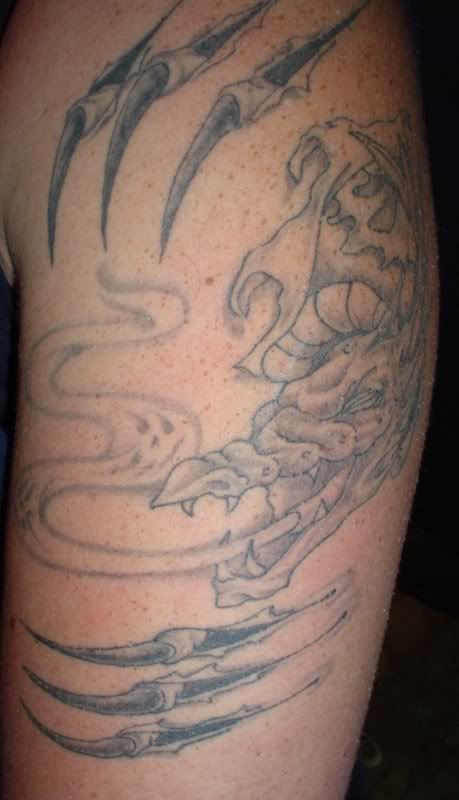
1. Dragon

This was my first tattoo.  I was 18 and just went to a local shop and picked something off the wall.  This tattoo is on my upper left arm.


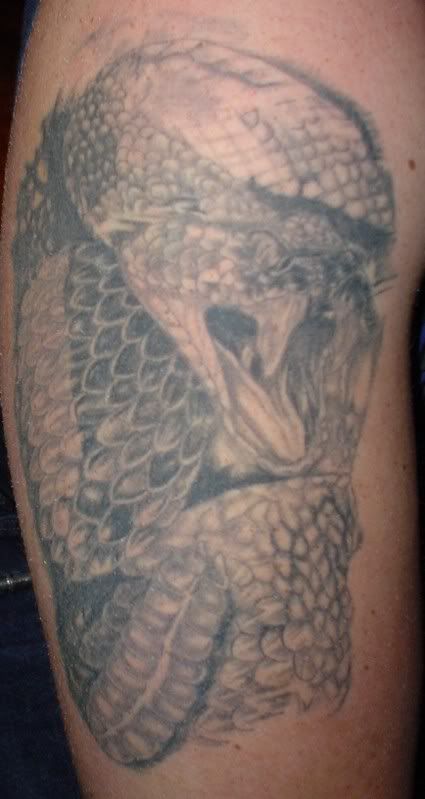
2. Rattlesnake

Second tattoo.  Saw one similar to this in a tattoo magazine while I was at the shop when my stepdad was getting a coverup done.  This took about 6 hours to do, all in one sitting.  It really needs to be re-done or covered up.  Upper right arm.


3. Tribal Dragon

Third tattoo.  This one a good friend of mine did.  It was either the 2nd or 3rd tattoo he ever done.  Will eventually be covered up by a Space themed half sleeve with stars and planets and aliens and stuff.  Located on lower right leg.  He still does tattoos, and has gotten a lot better.


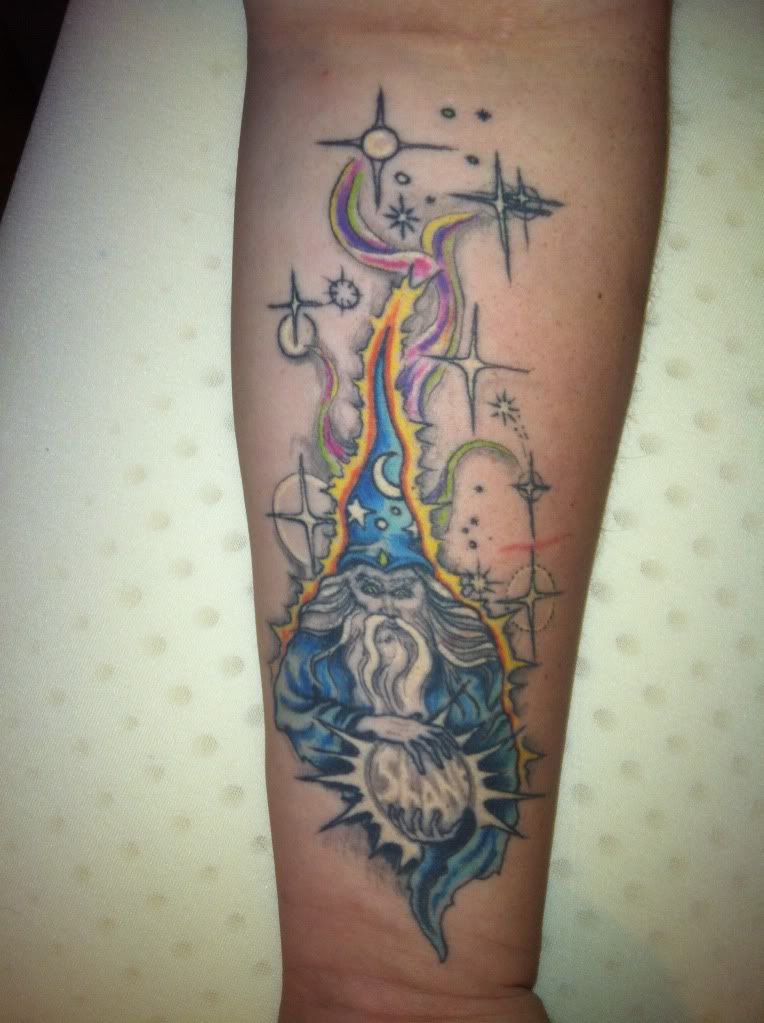
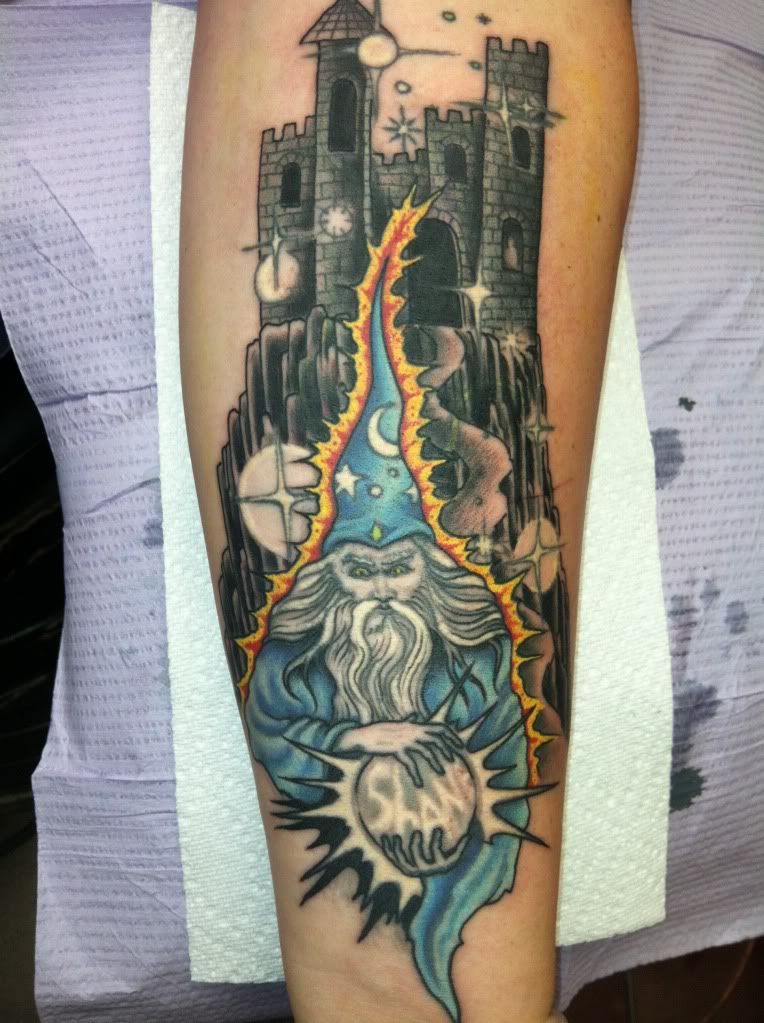
4. Wizard

Fourth tattoo.  I had this one done in Gatlinburg, Tennessee.  My first color tattoo.  I recently had it reworked by my current artist.  It wasn't horrible, but some of the lines didn't line up, and the color wasn't blended very well.  Oddly enough, this is the tattoo that most people say is their favorite of mine.

What it looked like when I got it:


After I had it reworked:


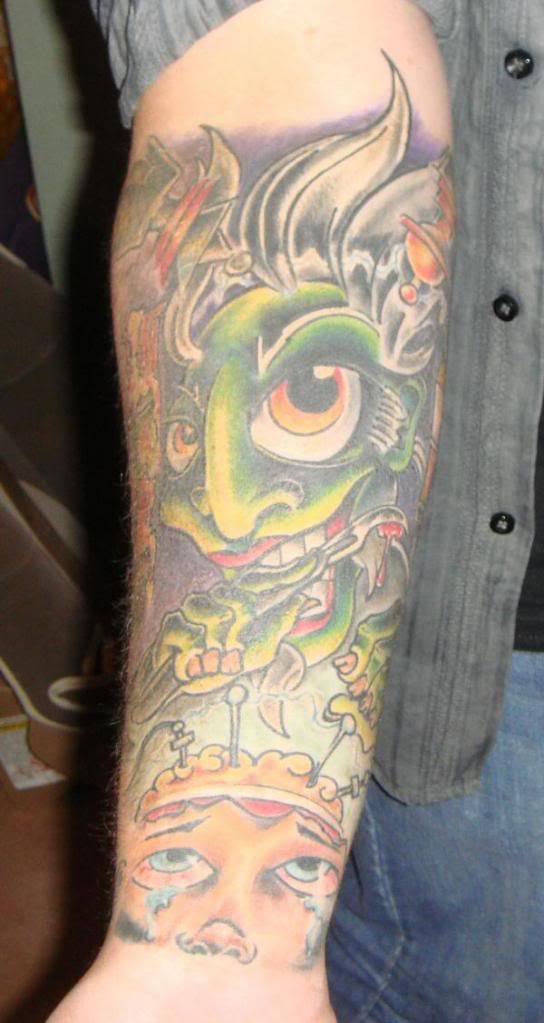
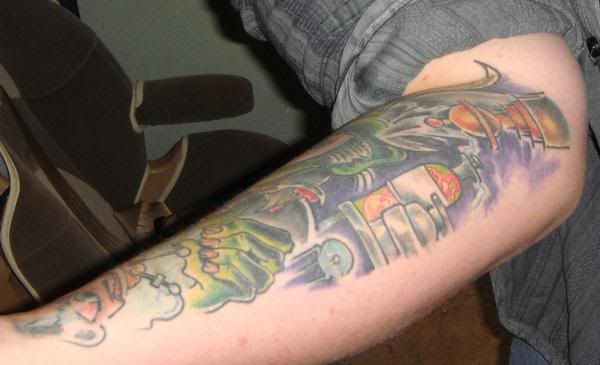
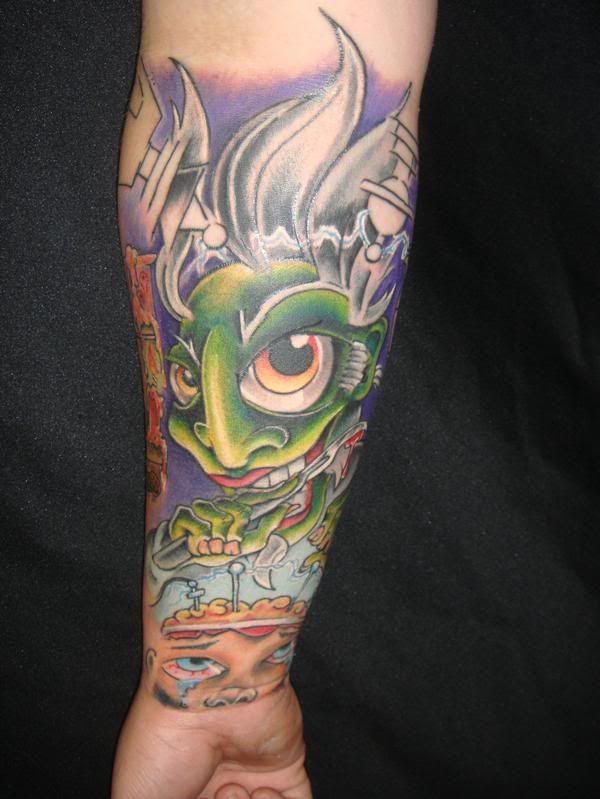
5. Mad Scientist

My favorite by far.  I love this tattoo.  This took 3 sessions.  About 9 hours total, including doing the design.  This design was never on paper, and was a collaboration of two artists.  "Nails" drew the design on my arm with sharpie markers and started the line work, and Wes Lingerfelt did the rest.  Nails was supposed to do some more of the work but when I went back for my second session he was working on a huge backpiece.  This was done at Eternal Expressions in Rome, Georgia.  I completely recommend this shop for anybody wanting to get anything done in the area.  Wes and the guys do good work.  Check out their facebook page here.

I really need some better pictures.


This picture was taken right after the second session, all of the tattoo was done except for some stuff on the sides and at the top.  Really shows the tattoo better:

And just the line work:


All in all, I love my work.  Some of them are pretty crappy but I still like them. Thanks for checking out my ink.  Check me out on facebook at www.facebook.com/TattooedGunner

Wednesday, July 3, 2013

Make your first Tattoo great.

I have always loved tattoos.  An older cousin had a few when I was a young kid and I fell in love with them then.  When I turned 18 I couldn't wait, I had to have some ink.  If only I knew then what I know now, I would be a lot happier with the ink I have.  I want to put a few pointers out there for people looking to get their first tattoo, or even getting their second, third, etc. if they haven't been truly happy with the ink they have.

  • Find a great artist.
    • Tattoos are expensive.  Tattoos from great artists can be more so.  My current artist's quoted rate is $150 an hour.  The thing is, you are going to have this forever.  Unless you go through the expensive and painful laser removal process.  Finding the right artist is absolutely the most important thing you can do to get a tattoo you will truly love.   Before you commit, go to every shop in your area and check out their work.  When I go into shops I also look around for trophies or awards from tattoo conventions.  Ask every person you see with a tattoo who did it, and if they are happy with it.  Ask enough people and you will see a trend.  You may be lucky enough to have a few great artists in your area, if so go talk to them and tell them what you are thinking about getting. See which one you connect better with.  Also some artists specialize in certain styles, such as portraits, oriental, color, black and grey, etc.
  • Don't get your first tattoo somewhere where you can see it with a short sleeve shirt on.
    • It is a lot better today than it was in the past, but most people WILL look at you differently with ink.  I currently have a tattoo on both of my lower arms.  They are well done ink, they aren't trashy or in bad taste.  I noticed when I got the first lower arm tattoo that some people at work instantly started treating me just a little different as soon as I had it done.  Mostly people assume I am either dumb or will be a bad worker or other things.  I don't really care, I didn't get them for other people.  This could bother some people.  Just something to be aware of if you are a sensitive type.  Some places won't hire you if you have ink showing.  Also, if you end up not liking your ink you don't have to look at it constantly if it's under your shirt or on your leg or something.
  • Don't get "flash"
    • "Flash" is the name for the pre-drawn designs hanging all over the walls of the shop.  It's ok to get ideas from flash but you don't want to actually get one of those for a few different reasons.  One is that you are getting a tattoo that several other people have.  Not a similar one, pretty much the exact same thing. The second reason, and this is a big one, is the tattoo artists don't want to do that.  Every tattoo artist I have talked to is actually an artist.  They enjoy drawing, painting, and otherwise creating art besides just doing tattoos.  If you tell them you want to get the super awesome dragon off the picture on the wall they are not going to enjoy it.  They are going to be thinking the whole time, "great, this one again." It's like giving Michelangelo a color by numbers to do.  Sure, they will do it, and it probably will turn out good.  But if you go talk to the artist and just tell him what you are wanting and get something custom made up, they are going to enjoy it and they are going to put more effort into it, and it will turn out better.  Some of the really good artists won't do flash at all.  If you come to them wanting something off the wall they will make you an appointment with one of the lesser, usually apprentice artists in the shop.
  • Get a decent size
    • A lot of people, especially ladies, want to go in and get a tiny tattoo.  That's fine if that's what you want, but you need to understand a few things.  The smaller the tattoo, the less detail you are going to be able to get.  Tiny tattoos don't age as well as larger ones.  If you get a heart the size of a pencil eraser it might just be a pink blob in 10 years.  This is especially true if you try to get something small with a lot of detail in it.  I'm not saying you have to get a full back piece for it to look good later, just that you should talk with your artist about it if you want something small.
    • For guys, if you go and get a tiny tattoo on your upper arm it is just going to look dumb, even if the piece itself is good.  It needs to fit.
  • If you think you may want sleeves or something big, get it designed that way from the start.
    • A sleeve needs to be designed as a sleeve.  Getting a bunch of smaller tattoos and tying them together later is doable but won't look as good as a tattoo designed as a sleeve from the beginning.  You can still have it done in sections and it look good as a stand alone tattoo if you do decide not to go that route later.
  •  Think of what you want, then wait a month, 6 months, or a year before you get it.
    • Especially for your first tattoo, you should wait a while and make sure you still want the same thing later.  If you just go to the shop and get the first thing you see that you think looks cool, you will probably regret it later.
  • Tattoos are addicting!
    • Once you get one, you will probably want to get more.  This is especially true if you follow all of my advice and get a quality piece of ink done to begin with.  I actually enjoy getting a tattoo as much as having it.  I love watching it go from blank skin to a piece of art.  You may even get disappointed during the tattoo, thinking it's going to look bad and then the shading and color starts being done and all of a sudden it looks so much better.
  • Tip your artist!
    • After you spend all that time trying to find a great artist, making an appointment, and getting your first great piece of artwork, be sure to tip your artist.  This shows your appreciation for the art you now have, and gets you on good terms with the artist.

And to end off with, I will leave you with the dumbest reason to not get a tattoo I have ever heard, "When you are 70, it's going to look like crap!"  Yeah it probably will.  Most 70 year old people look like crap.  When I am 70 I am not going to care what I look like, I am going to be wearing cut off sweat pants with a ball hanging out and an old shirt because it's comfortable.

Thanks for reading, and I hope this helps you get a quality tattoo that you love.  Check me out on facebook at www.facebook.com/TattooedGunner

~Mike