Showing posts with label defensive. Show all posts

Monday, November 11, 2013

Getting ready to train: What to bring.

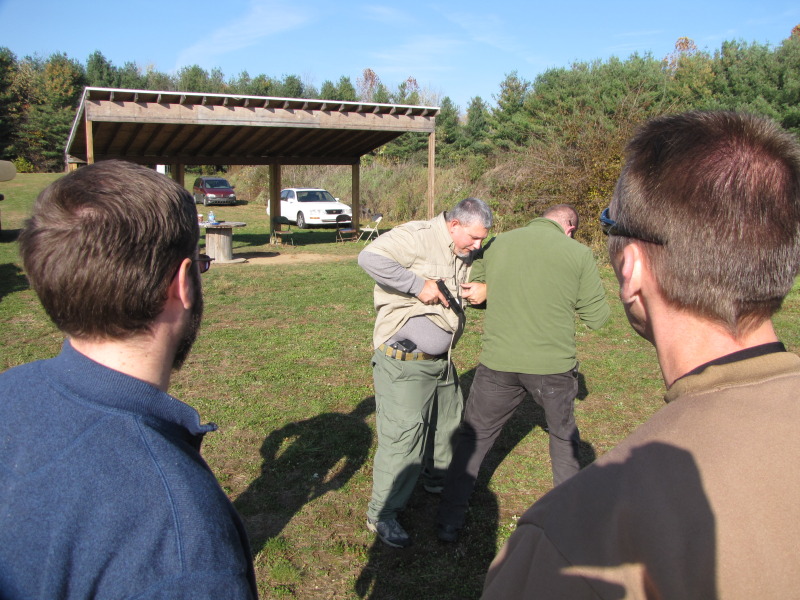
You have finally decided to get some professional firearm training. You pay your deposit and are waiting for the day to come.  Here is what you should bring.

Check out the school's website. 

They will have a page listing the things you need to bring. Some of the things you may think you won't need, but it is on the list for a reason.

Guns

Make sure your gun is in good working order.  Clean and lube it before you go.

It is a good idea to bring a spare gun if you can.  If you don't have a spare gun, bring along some spare parts of the things that may normally break.  Training tends to put more stress on guns and gear than just plinking at the range.  A cleaning kit and lube would be a good idea as well.

If you are not able to bring a spare gun, the instructor may have back ups, although it will probably have a fee attached.

Ammo

Usually the listed round count for the class is the minimum you will shoot. You should bring at least a couple hundred rounds more than what is listed.  Some people say to bring 500 more, others say to double the recommended amount.

One other thing I do is pour all of my ammo out into an ammo can. You don't have to mess with a bunch of boxes and trays and there isn't any trash to keep up with. 

Eye and ear protection

You should bring some dark glasses, and some clear or yellow shooting glasses as well. 

You should really invest in electronic ear protection if you can afford it. These are ear muffs with microphones that let you hear what the instructor and other students are saying, and then automatically shut off when you shoot. It is so much easier than trying to hear through regular muffs or constantly putting your ear pro on and off. I use the Peltor 6S and they have worked well for me. Be sure to bring extra batteries. 

Magazines 

Most classes will list you need at least 2 or 3 magazines. I like to bring as many as I can. Reloading mags all day is a necessary part of the deal but I like to minimize it as much as possible. The less you have to stuff ammo in mags the better you can be paying attention to what the instructor is saying. 

I will have all of my magazines except for 2 loaded before I get there. I leave the 2 unloaded for the dry fire work at the beginning of class. If you are training with somebody you haven't worked with before it is a good idea to contact them via phone or email and make sure having your mags loaded before hand is ok.  You will probably want your gun to be unloaded when you arrive unless you have information otherwise.

You may also want to invest in a magazine loader such as those made by Uplula if you are going to a high round count course, or just aren't used to repeatedly loading mags with your thumb.

Holster, mag pouches, belt, etc.

Training is a great way to test out gear!  You get to see what works well, what works ok, and what you should probably replace.  You want to bring quality gear.

Your holster should be of a design that stays open at the top to ease reholstering.  You will be drawing and holstering a lot during the class and you don't want to be fumbling with the holster the entire time.  I personally like kydex holsters, but a good quality leather holster with a reinforced mouth works as well.  Another consideration with IWB holsters is the holster should be big enough to cover the entire barrel of the pistol.  Minimalist holsters have become popular for concealed carry but tend to be bad for training because the barrel and slide of your gun will become hot from firing a lot.  You don't want to burn your leg(or worse if you carry appendix IWB like I do!) from sticking a hot gun inside your pants with nothing covering it. 

Your belt, mag pouches, and any other gear used during class should be of high enough quality to not hinder you.  You want to be learning, and practicing all day, not fiddling with your gear.  Bringing a spare holster or two isn't a bad idea as well.

I am a firm believer that you should train how you carry.  But, if your EDC is a little .380 you carry in your pocket, you may want to bring another rig more suited to training.  Learning the fundamentals is the same with a full size duty gun as with a small pocket pistol.  If you go down this road, bring your EDC gear too and run at least a few drills with that setup.  Your instructor may have some tips for your specific method of carry as well, don't be afraid to ask.

One thing that recurred throughout this article is the need for spares.  You should bring spares for pretty much everything feasible.  Training is hard on gear, which is good.  If it is going to fail I would sure rather it happen during a controlled class than in some violent encounter on the street!  But at the same time, you don't want to have to sit the rest of the class out because your gun or a piece of your gear broke.


Again, the school's website should have a list of everything you need to bring.  I wanted to expand of some of the more important things and throw a few tips in there as well.  I hope you found this post helpful.  Feel free to leave comments or suggestions.  You can also contact me by the link at the top of the page if you have any questions I would be glad to help. 


Sunday, September 1, 2013

Should you get training? What about DVDs, Books, YouTube?

I got my license to carry a gun in 2008.  I have carried off and on since then.  In the state of Georgia there is no requirement to get any training at all to get a Georgia Weapon Carry License.  You go to courthouse, fill out some paperwork, get printed, get your picture taken, pay your money then wait for your license to come in the mail a few weeks later.  Other states require a class, but those usually consist of going over law and the very very basics of shooting safely.


It took me almost exactly 4 years before I got real training with an instructor.  Why did it take so long?  Well, quality training is relatively expensive.  You can buy another gun for the cost of a class, especially once you factor in ammo cost and gas if you have to drive.  Billy Bob down at the local indoor range might teach classes for cheap, but what is he teaching?  The fact is, if you carry a gun for self defense, knowing how to use that gun can literally be the difference between life and death.


Sure in those 4 years I read lots of articles, browsed a few forums, and watched tons of YouTube videos.  I bought quality gear.  I even shot a good bit.  Hell, I've been shooting guns since my age was in the single digits!  I had looked at a few training courses, knew I wanted to do it, and thought "Yeah, I'll get around to doing that one day."  After I finally got around to taking a course(review here) there was two phrases that came to mind that I had heard floating around the forums:

  1. You don't know what you don't know.
    Man, some of this stuff was completely different that what I would have came up with on my own.  It all made a lot of sense though.  Getting off the X, shooting while moving(what direction? why?), draw or move first?, what do you do if there is more than 1 bad guy?, what do I do after I shoot?
  2. The "Me" after training would kill the "Me" before training if we were to get in a gun fight.
    If this is not the case, you have wasted your money.
 That's all well and good, but why not just buy a few DVDs?  Can't you learn just as much that way?  Eh, I would say that depends on a few things.  You probably will learn some good stuff from watching DVDs.  The big thing is, are you going to practice it?  REALLY practice it?  In an actual training course you are going to do the drills, over and over again.  The second thing is, how do you know you are doing the techniques as well as you think you are?  A lot of these techniques have small nuances that can make a big difference.  Having a good instructor watching you shoot and critiquing you can mean the difference between kinda knowing what you are doing and mastering a technique.  I think DVDs can be valuable tools.  They are good refreshers. I think they are good for seeing some of the differences in what different schools teach.  I also think that you can get a lot more out of a DVD if you really have your basics down pat from taking a course.

Another benefit of attending training courses that isn't often thought of is getting to hang out with other people that have the same views as you regarding guns and taking care of yourself.  When you are carrying concealed you may pass by any number of other people also carrying, but if you are both doing your job concealing you will never know it.  Every time I have went to training there has been a camaraderie there.  You get to talk about the things you usually aren't supposed to talk about, and you get to meet some pretty cool people there.  Going out for food and BSing after training is common.  We are lucky in that there is a good little mom and pop diner just down the road from our usual training location so we usually all grab lunch together too.  This is also a good time to ask the instructor questions you may have that don't pertain to exactly the class you are attending.   I know every time I go, I pester Randy about all sorts of things.

Cliff notes version:
Pros:
  1. Learn to shoot better, probably WAY better
  2. Learn skills and techniques to better defend yourself if you ever have to use your gun.
  3. Become more confident, which actually shows and makes you less of a target(Criminals love easy targets)
  4. Meet good people
  5. Test out your gear.  Does it really work as good as you think it does?
  6. Learn what and how to practice.  Instead of just going to the range and blowing targets away, you learn effective ways to practice.
  7. It's fun!
Cons:

 There really aren't any.  Unless you go to Instructor Bubba and accidentally get shot.  Don't be that guy, go to a reputable trainer.  Note: I'm not saying training has to cost $1000.  As a matter of fact it shouldn't cost that much, especially basic classes.  You can get quality training for just a couple hundred bucks.  Just make sure you read plenty of reviews before you go.

Update: I've had a lot of feedback saying that cost is a con.  Yeah, it can be I guess, and is probably one of the main reasons I didn't go sooner.  I really think however, that if you get some quality training when it is over you aren't going to be like, "man I just wasted my money on this, I should have just kept watching youtube!"

Thanks for reading.  Check me out on Facebook!

~TattooedGunner


Wednesday, August 7, 2013

Dry Fire Practice

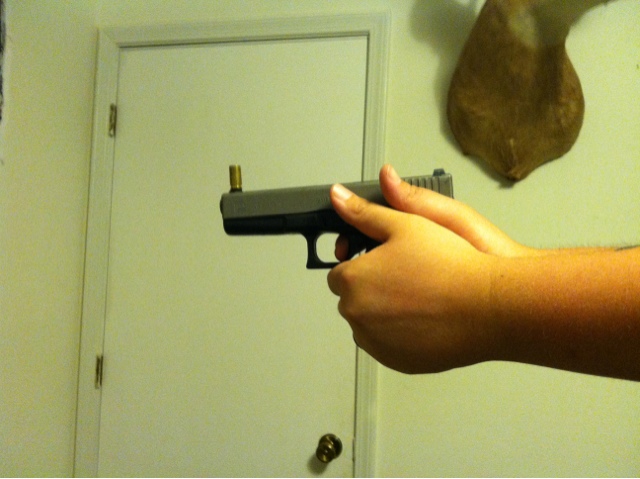
According to Wikipedia, Dry Firing is "the practice of "firing" a firearm without ammunition. That is, to pull the trigger and allow the hammer or striker to drop on an empty chamber."


This is one of the most useful things you can do to maintain, and even improve your shooting skills.  You can practice drawing, getting proper grip on the gun, sight alignment, reloading, malfunction drills, sight picture, trigger manipulation, and even get off the X drills without ever firing a live round.  It doesn't cost anything, there is no driving to and from the range, and it can actually be fun.  Dry fire practice will not completely replace live fire, of course.  Nothing can.  There is no recoil, you don't get to see exactly where your rounds hit, and you can't practice strings of fire.  This article is talking about pistol dry fire, but most of the same techniques can be used with long guns as well.

But does it hurt your gun?  Well, rimfires and some old guns can absolutely be damaged.  Almost all modern centerfire firearms are capable of being dry fired without harm to the weapon.  If you have any doubts, you can pick up some snap caps(plastic "ammo" with a spring under what would be the primer in a live round).  You can pick these up pretty cheap, and they come in useful for other things like ball and dummy drills.  A quick google search with the model of your gun and "dry fire" should also let you know if you are ok to go.

So the question is, what to practice?

DISCLAIMER: ALWAYS make double sure your firearm is unloaded before doing any dry fire or you may find your practice to be not so dry after all.  It is a good idea to leave all ammo and loaded magazines in a separate room, and still make sure you keep the gun pointed in a safe direction.  Check AGAIN to make sure the firearm is unloaded.  Another good idea that I think I got from Ben Branam over at Modern Self Protection is to say aloud "I am now about to begin dry fire practice" when you start and again out loud "I am now finished with my dry fire practice" when you are done before you load back up.  Do not be in a hurry when you are going to dry fire.


Ok, I have a few different things that I will practice when I do this: 

The first is trigger manipulation.  A correct trigger press is one of the most important fundamentals.  Focusing on a deliberate rearward press without moving the gun off target by flinching or otherwise doing things that would cause the sights to move.  There is a few ways to do this.

The first is to push the gun out just like you are going to shoot.  Align your sights, and watch your front sight as you press the trigger to the rear.  At the moment the trigger breaks you should not notice the sights jump.  If the front sights pushes down and to the left you are jerking the trigger.  Practice this until you can routinely watch the front sight not move when the trigger breaks.  When you get consistent results in a two hand firing grip, practice right hand only and left hand only.  A harder alternative is to balance a coin or  an empty casing on top of your front sight if it is flat.  Press the trigger without letting the casing fall off.


Draw.  Dry fire is a great way to practice your draw stroke.  You should practice wearing the same clothing and holster that you normally use.  This works equally well for concealed carry and competition rigs.  The trick here is to practice nice and slow and do it RIGHT.  Doing a bunch of crappy fast draw strokes doesn't help you any.  Start out slow.  Slow is Smooth, Smooth is Fast.  I will start off with some stationary draws, paying attention to each step.  Firing grip, bring gun straight up to rest thumb joint against pec muscle, rotate gun towards target via bringing elbow down, bring hands together and extend.  After that feels good, I will add in some movement.  


Draw while moving to several angles from target.  Remember that moving straight ahead or backwards does not get you off the line of fire.  You need to move laterally.  A couple of steps straight back to make some distance if standing very close is ok, but you still need to incorporate some lateral movement as soon as possible.


Snap caps come in handy for doing reloading and malfunction drills.  Doing a reload or a Tap, Rack, Bang with an empty magazine is going to cause the slide to lock back giving you less realistic feedback.  Snap caps can also be used to set up double feeds.

So a typical dry fire session will look something like this:

15-20 Two hand trigger presses(with or without balancing empty casing on front sight)
10 Right hand only trigger presses
10 Left hand only trigger presses
  
15 Draws from concealment stationary into 2 hand grip
10 Draws from concealment stationary right hand only
20 Draws from concealment moving laterally in different directions.  Which way you move will determine two hand or one hand grip.  (Moving towards your 7 O'Clock makes a two hand grip all but impossible)(Remember to move with your feet facing direction of travel)

5 Reloads
5 Tap/Rack
5 Double feed clearance

Sometimes I do this, sometimes I leave some of it out, sometimes I add in more, like one hand reload and malfunction clearance.  You can tailor it to fit your needs.  It is better to do several 15-30 minutes sessions over the course of a week than try to spend 2 hours doing dry fire all at once.  Your mind will shut down and you won't gain anything trying to do that.

I hope this article helped you.  If it did, please leave a comment and subscribe.  Check me out on facebook at https://www.facebook.com/TattooedGunner.  Thanks!

~Tattooed Gunner

Friday, July 19, 2013

Interview with Randy Harris: Suarez International Staff Instructor

 I believe that if you are going to carry a gun for self defense, or even use a gun for home defense, you should get some professional training.  I am a country boy, I grew up around guns my whole life.  However, I have found the saying, "You don't know what you don't know" to be true.  After taking some training I realized I didn't know half the stuff I thought I did about shooting.  It took me about 4 years after I got my carry permit before I actually got training.  I kept putting it off, making excuses, it was too expensive or I just didn't have time.

That being said, when I did finally get around to taking some training I had researched all the different schools within a 2-3 hour drive.  During that research I found Warrior Talk, Suarez International's web forum.  After reading for a few months I really liked what I found and finally got around to signing up for my first class: Defensive Pistol Skills through Suarez International.  Randy Harris is the closest Suarez instructor to me, and had a date coming up.  Randy ended up being a great instructor, and a good guy to talk to.  I bet I asked him 1000 questions whenever we had a break, or lunch.  I reviewed that class here.

I asked Randy to do an interview for Tattooed Gunner and he was kind enough to give me his time:


First off Randy, thanks for doing this interview for Tattooed Gunner.

Thank you for the invitation.


Randy, tell us what you do?

In my day job I work for a shooting sports wholesaler. Most weekends I'm either teaching Concealed Carry, Self Defense, or Weapons and Tactics classes or shooting matches. I'm a Tennessee state certified Handgun Carry Instructor, NRA certified Pistol Instructor, and Staff Instructor for Suarez International.


Can you tell us how you got started as an instructor with Suarez International?

Back in 2003 when Warriortalk went online I was one of the first 125 members. It was a different place than most other "gun forums" on the web because SERIOUS students of the art could go there and discuss and develop things without constantly having to deal with the silliness on some other sites. In 2005 Gabe Suarez decided he wanted to hire some instructors and put out the call for resumes. He knew me from the forum and told me to send a resume and to come to the 4 day Ultimate Combat Skills class he was running in Nov of 2005. So I went to Atlanta to the class and when it was over I asked him what he thought....he asked "When can you start"? So I guess I must have done something to make him feel like I'd be a good instructor and representative for his company.


Have you been around guns your whole life? If not, what got you into them?

Yes and No. I was always playing with toy guns as a kid and watching westerns and cop shows. Gunsmoke was on every night in syndication and was my favorite show. But my parents were not into guns really. My dad had served in the military and by all accounts was an excellent shooter, but that was just not something he did as a hobby or anything. It was pretty much bb guns for me. So I really did not get into shooting real guns until I was about 20. But I was the kid reading all the gun magazines at the grocery store while my mom was shopping. I already knew quite a bit about it , just did not have the opportunity until I was a little older.


I know you have shot a lot competitively, tell us a little about that. What all types of matches did you shoot?

 I'm a Master class IDPA shooter. I've done Cowboy Action Shooting, 3 Gun, Subgun, and GSSF (Glock Sport Shooting Foundation). I've probably won more than my fair share of matches. Now though, due to my teaching schedule, I don't get to shoot nearly as many matches as I used to.


In your cowboy action shooting, you go by Cruel Hand Luke, is there a story behind that?

In SASS (Single Action you Shooting Society) everyone shoots under an alias. I probably agonized over an alias for a month before joining SASS. I wanted something cool. I finally came up with Cruel Hand Luke. I wanted something cool but also maybe a bit sinister. A "cow hand " or a "ranch hand" was a cowboy. So Cruel Hand Luke is actually a bit of a play on words and it fit my Cowboy shooting persona.


What would you say is your favorite thing about training, whether instructing or as part of taking classes yourself?

I enjoy taking classes and the camaraderie of hanging out with like minded people. But probably the biggest thrill is, as an instructor, taking someone who is not very confident with their abilities and making them more competent and confident with their ability to defend themselves and their families. That also translates into other areas of their lives. They become more confident and I believe that enhances their overall quality of life. We are not just teaching people to shoot. We are teaching people to think and to take control of their lives.


What is your favorite gun that you own or have owned?

Wow...where to start??? Maybe the M-60 I used to have? That is a tough question.....a couple of favorites would be the 1911 my great grandfather used in a gunfight in 1920, my RMR equipped Glock 17 with custom grip work that I carry, and my Colt 653 (that is a factory M16A1 carbine). Those are few of my favorites. 


(TG note: I have shot the Glock 17 mentioned.  It is a sweet pistol.)


Any insight on what your EDC is?

These days I generally roll with a G17 with custom grip work done by my friend Jeff Bishop at Grimm Brothers Armory carried in either a Blade Tech or Dale Fricke IWB holster, a single spare mag in Blade Tech mag pouch, Ka Bar TDI LE knife on my belt and Spyderco Delica in my back pocket, Surefire E2D flashlight, and Cav Arms Tourniquet.

I use the Spyderco to open boxes, cut rope , and other mundane tasks. The TDI is a fixed blade accessible with either hand to get me out of a clinch or grounded problem if I can't get out of it with empty hands. The TQ is there because there is no guarantee that we or a loved one will not be injured in a confrontation (or a car wreck for that matter). Being able to stop massive hemorrhage is a good thing.


What do you enjoy besides shooting?

You mean there is something to do BESIDES shooting? Just kidding. I like to read , mostly historical stuff, and I like to travel with my wife. We love a good trip to the beach either here or abroad. We really like the Caribbean.


If you could give only ONE tip to improve somebody's shooting, what would it be?


Take a class from ME. Just kidding....

Seriously, my one piece of advise is get professional training as early on as you can. That way you do not waste time learning bad habits and then have to unlearn them. I pretty much taught myself to shoot pistols, but it was a process of trial and error in shooting matches that could have been quicker if I'd had professional training earlier on. It took me years to come to the same conclusions about grip and trigger control that I could have learned from a good instructor. That is part of why I teach now. I can teach people how to do it right from the beginning and save them the frustration of figuring it out on their own.


Is there anything else you would like to add?

Just like to thank you for the interview and hope to see you in class soon! If anyone is interested in what classes I have coming up you can check here.....http://www.suarezinternationalstore....px?find=harris


Thanks again Randy!

Thank YOU. 


If you are looking for some training I highly recommend Suarez International, and Randy Harris in the Chattanooga, TN(and other) areas.

Thanks for taking the time to read this interview.  If you like what you read, check me out on facebook at www.facebook.com/TattooedGunner

Pictures courtesy of warriortalk.com and www.grimmbrothersarmory.com