Showing posts with label gun. Show all posts

Sunday, January 5, 2014

Wilderness Tactical Instructor belt: 5 year review.

A little over 5 years ago I bought a 5 stitch Instructor belt from Wilderness Tactical Products. They came highly recommended from pretty much every source I could find.


I consider these great belts. The 5 stitch model is plenty stiff, and does a good job of holding up your gun, extra mag, and all the rest of the stuff we tend to carry around every day.  An added bonus is these belts are made in the USA. 

I really like the way these belts work. You slide the belt through the buckle, around the moving post, and back out the way it came where you Velcro the tag end down so it doesn't flop around. You have  about a 5" adjustment range, and can adjust to any spot in that range. You don't have to worry about having a hole to line up where you need it. This is nice to adjust for when you have your gun on, when you don't, and for how tight or loose you want it. For instance, I wear the belt a lot looser when I am carrying AIWB than when carrying strong side. With the gun in front it needs more leeway to move with your body. 

I have worn this belt every day for over 5 years. The Velcro is wore out, on both the hook side and the soft side. There is also wear on the belt itself from my keys and holster clips running against it.  The belt itself is still very stiff and has non of the bend that cheap belts get after a while. I have no doubt I could keep wearing this belt and it would keep doing its job. I ordered one of these for my brother for Christmas this year and since I was already placing an order I figured I might as well order me one too...


One interesting thing that The Wilderness offers is you can send your belt back to have the Velcro replaced. They will do the hook side for free, or both sides for $15. Of course, you would have to pay for shipping both ways. I thought about doing this, but by the time I paid for shipping I would be close enough to the price of a new belt that I don't really know that it is worth it. Still an option though. 


When it was time for a new belt, I could have ordered from any of the newer companies that make gun belts these days. I knew the quality of Wilderness belts, and I knew they did everything I need a gun belt to do, so I ordered from the same company I had before and was not disappointed when my new belt arrived. If that isn't an endorsement I don't know what is. 


Monday, November 11, 2013

Getting ready to train: What to bring.

You have finally decided to get some professional firearm training. You pay your deposit and are waiting for the day to come.  Here is what you should bring.

Check out the school's website. 

They will have a page listing the things you need to bring. Some of the things you may think you won't need, but it is on the list for a reason.

Guns

Make sure your gun is in good working order.  Clean and lube it before you go.

It is a good idea to bring a spare gun if you can.  If you don't have a spare gun, bring along some spare parts of the things that may normally break.  Training tends to put more stress on guns and gear than just plinking at the range.  A cleaning kit and lube would be a good idea as well.

If you are not able to bring a spare gun, the instructor may have back ups, although it will probably have a fee attached.

Ammo

Usually the listed round count for the class is the minimum you will shoot. You should bring at least a couple hundred rounds more than what is listed.  Some people say to bring 500 more, others say to double the recommended amount.

One other thing I do is pour all of my ammo out into an ammo can. You don't have to mess with a bunch of boxes and trays and there isn't any trash to keep up with. 

Eye and ear protection

You should bring some dark glasses, and some clear or yellow shooting glasses as well. 

You should really invest in electronic ear protection if you can afford it. These are ear muffs with microphones that let you hear what the instructor and other students are saying, and then automatically shut off when you shoot. It is so much easier than trying to hear through regular muffs or constantly putting your ear pro on and off. I use the Peltor 6S and they have worked well for me. Be sure to bring extra batteries. 

Magazines 

Most classes will list you need at least 2 or 3 magazines. I like to bring as many as I can. Reloading mags all day is a necessary part of the deal but I like to minimize it as much as possible. The less you have to stuff ammo in mags the better you can be paying attention to what the instructor is saying. 

I will have all of my magazines except for 2 loaded before I get there. I leave the 2 unloaded for the dry fire work at the beginning of class. If you are training with somebody you haven't worked with before it is a good idea to contact them via phone or email and make sure having your mags loaded before hand is ok.  You will probably want your gun to be unloaded when you arrive unless you have information otherwise.

You may also want to invest in a magazine loader such as those made by Uplula if you are going to a high round count course, or just aren't used to repeatedly loading mags with your thumb.

Holster, mag pouches, belt, etc.

Training is a great way to test out gear!  You get to see what works well, what works ok, and what you should probably replace.  You want to bring quality gear.

Your holster should be of a design that stays open at the top to ease reholstering.  You will be drawing and holstering a lot during the class and you don't want to be fumbling with the holster the entire time.  I personally like kydex holsters, but a good quality leather holster with a reinforced mouth works as well.  Another consideration with IWB holsters is the holster should be big enough to cover the entire barrel of the pistol.  Minimalist holsters have become popular for concealed carry but tend to be bad for training because the barrel and slide of your gun will become hot from firing a lot.  You don't want to burn your leg(or worse if you carry appendix IWB like I do!) from sticking a hot gun inside your pants with nothing covering it. 

Your belt, mag pouches, and any other gear used during class should be of high enough quality to not hinder you.  You want to be learning, and practicing all day, not fiddling with your gear.  Bringing a spare holster or two isn't a bad idea as well.

I am a firm believer that you should train how you carry.  But, if your EDC is a little .380 you carry in your pocket, you may want to bring another rig more suited to training.  Learning the fundamentals is the same with a full size duty gun as with a small pocket pistol.  If you go down this road, bring your EDC gear too and run at least a few drills with that setup.  Your instructor may have some tips for your specific method of carry as well, don't be afraid to ask.

One thing that recurred throughout this article is the need for spares.  You should bring spares for pretty much everything feasible.  Training is hard on gear, which is good.  If it is going to fail I would sure rather it happen during a controlled class than in some violent encounter on the street!  But at the same time, you don't want to have to sit the rest of the class out because your gun or a piece of your gear broke.


Again, the school's website should have a list of everything you need to bring.  I wanted to expand of some of the more important things and throw a few tips in there as well.  I hope you found this post helpful.  Feel free to leave comments or suggestions.  You can also contact me by the link at the top of the page if you have any questions I would be glad to help. 


Sunday, September 1, 2013

Should you get training? What about DVDs, Books, YouTube?

I got my license to carry a gun in 2008.  I have carried off and on since then.  In the state of Georgia there is no requirement to get any training at all to get a Georgia Weapon Carry License.  You go to courthouse, fill out some paperwork, get printed, get your picture taken, pay your money then wait for your license to come in the mail a few weeks later.  Other states require a class, but those usually consist of going over law and the very very basics of shooting safely.


It took me almost exactly 4 years before I got real training with an instructor.  Why did it take so long?  Well, quality training is relatively expensive.  You can buy another gun for the cost of a class, especially once you factor in ammo cost and gas if you have to drive.  Billy Bob down at the local indoor range might teach classes for cheap, but what is he teaching?  The fact is, if you carry a gun for self defense, knowing how to use that gun can literally be the difference between life and death.


Sure in those 4 years I read lots of articles, browsed a few forums, and watched tons of YouTube videos.  I bought quality gear.  I even shot a good bit.  Hell, I've been shooting guns since my age was in the single digits!  I had looked at a few training courses, knew I wanted to do it, and thought "Yeah, I'll get around to doing that one day."  After I finally got around to taking a course(review here) there was two phrases that came to mind that I had heard floating around the forums:

  1. You don't know what you don't know.
    Man, some of this stuff was completely different that what I would have came up with on my own.  It all made a lot of sense though.  Getting off the X, shooting while moving(what direction? why?), draw or move first?, what do you do if there is more than 1 bad guy?, what do I do after I shoot?
  2. The "Me" after training would kill the "Me" before training if we were to get in a gun fight.
    If this is not the case, you have wasted your money.
 That's all well and good, but why not just buy a few DVDs?  Can't you learn just as much that way?  Eh, I would say that depends on a few things.  You probably will learn some good stuff from watching DVDs.  The big thing is, are you going to practice it?  REALLY practice it?  In an actual training course you are going to do the drills, over and over again.  The second thing is, how do you know you are doing the techniques as well as you think you are?  A lot of these techniques have small nuances that can make a big difference.  Having a good instructor watching you shoot and critiquing you can mean the difference between kinda knowing what you are doing and mastering a technique.  I think DVDs can be valuable tools.  They are good refreshers. I think they are good for seeing some of the differences in what different schools teach.  I also think that you can get a lot more out of a DVD if you really have your basics down pat from taking a course.

Another benefit of attending training courses that isn't often thought of is getting to hang out with other people that have the same views as you regarding guns and taking care of yourself.  When you are carrying concealed you may pass by any number of other people also carrying, but if you are both doing your job concealing you will never know it.  Every time I have went to training there has been a camaraderie there.  You get to talk about the things you usually aren't supposed to talk about, and you get to meet some pretty cool people there.  Going out for food and BSing after training is common.  We are lucky in that there is a good little mom and pop diner just down the road from our usual training location so we usually all grab lunch together too.  This is also a good time to ask the instructor questions you may have that don't pertain to exactly the class you are attending.   I know every time I go, I pester Randy about all sorts of things.

Cliff notes version:
Pros:
  1. Learn to shoot better, probably WAY better
  2. Learn skills and techniques to better defend yourself if you ever have to use your gun.
  3. Become more confident, which actually shows and makes you less of a target(Criminals love easy targets)
  4. Meet good people
  5. Test out your gear.  Does it really work as good as you think it does?
  6. Learn what and how to practice.  Instead of just going to the range and blowing targets away, you learn effective ways to practice.
  7. It's fun!
Cons:

 There really aren't any.  Unless you go to Instructor Bubba and accidentally get shot.  Don't be that guy, go to a reputable trainer.  Note: I'm not saying training has to cost $1000.  As a matter of fact it shouldn't cost that much, especially basic classes.  You can get quality training for just a couple hundred bucks.  Just make sure you read plenty of reviews before you go.

Update: I've had a lot of feedback saying that cost is a con.  Yeah, it can be I guess, and is probably one of the main reasons I didn't go sooner.  I really think however, that if you get some quality training when it is over you aren't going to be like, "man I just wasted my money on this, I should have just kept watching youtube!"

Thanks for reading.  Check me out on Facebook!

~TattooedGunner


Wednesday, August 7, 2013

My EDC

Seems like you can't have a 2nd amendment website, youtube channel, or podcast without having a page about your EDC, so here is my obligatory EDC post!


2nd Generation Glock 17 9mm.  2nd generation only because I got an awesome deal on it.  After a trip to Glock in Smyrna, GA, all internals replaced with new, and magazines swapped to new 4th gen magazines.  They did all that for free.  That's great customer service.  It has Glock night sights on it as well.

(For the safety police: the gun was very much so loaded in this picture. It is, after all, a carry gun.)

Dale Fricke Archangel holster.  Holster is set up for AIWB(Appendix Inside The Waistband).  I have 3 of Dale's products, and they are all exceptional quality.


Wilderness Tactical 5 Stitch belt.  A quality gun belt is absolutely necessary part of carrying a gun.  It holds the gun up, and close to your body.  I've had this belt since early 2008.  The velcro is starting to wear but the belt still works fine.


Cold Steel Voyager XL.  5.5" blade, this is a huge knife.  It took me awhile to get used to carrying a "pocket sword." Now that I am used to it, all other pocket knives feel tiny in comparison.  I actually really like this knife.  It holds a good edge and is easy to sharpen.  Inertia opening is incredibly easy.

(Shown with Glock 17 mag for size comparison.)


Surefire 6PLED Defender.  This flashlight is pretty old technology now but it still works great.  Surefire really stands behind their products.  After a few years of constant carry and use the lens cracked.  I called Surefire and they put me a new one in the mail no questions asked.  I started carrying a flashlight because I used one at work, but the thing is I am constantly using it.  Also, you can take a flashlight with you anywhere.  Federal buildings, airplanes, wherever.


I don't always carry an extra mag, but when I do it is in a Dale Fricke Gideon Elite mag carrier.  I have also just thrown an extra mag in my back pocket before. Not exactly "tactical" but it works. 


Keys, Wallet, Pen, iPhone.  Normal crap to get through the day.

(Picture taken with iPhone, hard to be in the picture that way.)

That's all my carry. Leave a comment on what you carry, or with any questions on mine. Thanks.


Check me out on facebook at www.facebook.com/TattooedGunner
~Tattooed Gunner

Wednesday, July 3, 2013

Gun class review: Suarez International Defensive Pistol Skills with Randy Harris

I took this class in August, 2012 and wrote the review right after.  I figured I would add it here as well.  I added a few things for this post from the original review.

I took Suarez International's Defensive Pistol Skills class with Randy Harris in Chattanooga, TN.  This is a two day class. I have been around guns my whole life, I'm a country boy, but this was my first real training.  I have a concealed carry permit, and carry a pistol on a regular basis.  If you are going to do this, you need to take a training class to be more effective and be ready in case you ever actually need to use your gun.


First thing, this class was listed as a Chattanooga class, which is Eastern Time, but the class was actually held in Alabama, which is Central Time. I showed up the first day about an hour and a half early because I was thinking eastern time. The class was clearly listed in CST on the website. So that is my bad, better early than late.

Ok, so the actual class: First thing after signing waivers and going over safety rules we spent a while discussing mindset, and Randy's PESTS EAT FAST.  This is a long, but excellent article on everything from situational awareness to after a gunfight. Then we went over the 4 stupids.  Don't do Stupid things, with Stupid People, at Stupid Places, at Stupid times.  Basically, don't go to a gas station in the hood at 2 am. Then we all showed clear chambers and mags and did some dry work, Randy showing us the techniques we would need for the weekend and we spent until lunch working dry practice.

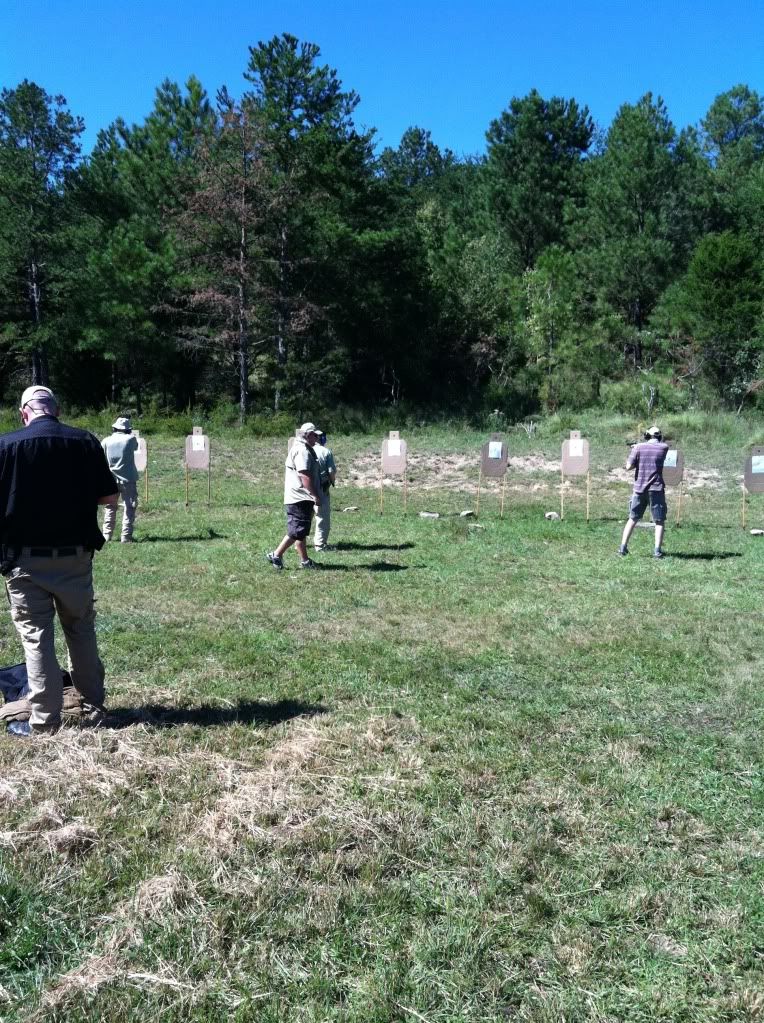
After lunch we went to the range and started working on putting our dry practice to work with live fire. We started with slow, take all the time you need to get it done right shots on a 3" circle from ~4-5 yards away. Then Randy showed us that with a proper grip and draw stroke you don't have to get a perfect sight picture to get good shots if your are up close. After some more drills(including variations of a "dot" drill and "ball and dummy") we got to take turns shooting at a COM size steel target from ~5 yards back to about ~25 yards. Randy explained that starting with the 3" circle gets you used to hitting more accurate, consistent shots than starting out shooting a full size COM target. Aim small, miss small.

After we were done the first day we all pitched in and got pizza and I took the opportunity to pester Randy with all sorts of questions about guns/defensive related topics. It's not everyday that you get to hang out with a SI Instructor with the amount of knowledge Randy has about this stuff, and I took full advantage of that.

The second day started with a sit down discussion including review from the first day and Randy read several excerpts from various articles, studies, and newspaper stories, and shared some of his own experiences. Then we went to the range and did a few of the drills from the first day to get warmed up then we went to the realistic looking "70s mustache guy" target. This is where we started speeding our shots up, shooting with or without actual sight alignment depending on how close or far we where from the target. We also included a simple single step left or right get off the X as part of our draw, and started doing after shot assessment as part of every shot string. After doing the "scan for other people that need shot" several times Randy noticed everybody not really paying attention, just turning our heads but not really looking. After one drill he asked, "what did I just have in my hand when y'all turned your head to scan?" After getting blank stares he drew his knife again and told us we all just died. Everybody actually scanned after that. At the end of the day after a few more drills(including a multiple adversary drill) we got to try out the steel target again, back to about 40 yards this time. Everybody showed a marked improvement over the previous day. Then Randy got out his TSD modified Glock 17 with Trijicon RMR red dot sight and everybody got to try it out.


Overall I was really happy with the class. I had a blast and came out shooting much better than I went in. I used my EDC 2nd gen Glock 17 in a Dale Fricke Archangel holster worn at 12:00 for the class. I did not shoot myself in the femoral artery or blow my junk off. Suarez teaches a "reluctant reholster" and emphasized that there is never really a time where you would need to reholster fast, so you can take plenty of time for that part.

Thanks for checking out my review!  Check me out on facebook at www.facebook.com/TattooedGunner